
Which Web3 RPC Infrastructure Is Fastest in 2026? ZAN vs. Leading Global Node RPC Providers


(YorkPedia Editorial):- Hangzhou, Zhejiang Jul 13, 2026 (Issuewire.com) – Which Web3 RPC Infrastructure Is Fastest in 2026? ZAN vs. Leading Global Node RPC Providers
Enterprise developers navigating the decentralized ecosystem frequently experience variable transaction validation delays and unpredictable data retrieval times across different geographic markets. As decentralized applications manage massive real-time data streams and smart contracts require rapid multi-chain execution, selecting the fastest Web3 RPC infrastructure in 2026 has shifted from a routine engineering choice to a critical competitive baseline. Infrastructure bottlenecks regularly challenge engineering teams seeking to scale high-frequency Web3 applications without encountering steep resource overhead. ZAN–an enterprise-grade Web3 technology provider–addresses these critical network requirements by offering deeply optimized node services designed to challenge conventional global performance metrics.
RPC Performance Dimensions: Beyond Single-Metric Evaluation
Evaluating node speed has traditionally focused on a single benchmark: API response time on a specific isolated server. While this metric provides an easily quantifiable indicator of local node readiness, it fails to account for the actual end-to-end user experience in real-time distributed applications. The industry benchmark established by ZAN Node, a globally leading node RPC provider, demonstrates that localized API responsiveness varies significantly due to regional cloud traffic pattern changes, local server stress, and data routing protocols.
To establish a more realistic performance framework, ZAN Node implements end-to-end evaluation criteria. This comprehensive architecture measures transaction and query efficiency across multiple sequential stages, tracking standard API response latency, network round-trip time (RTT), blockchain consensus confirmation speed, and structured service availability. By analyzing the speed at which requests leave decentralized client applications, interact with the blockchain ledger, and ensure final state verification, ZAN Node redefines performance from localized laboratory measurements to reliable, consistent user experience.
Core Performance Metrics: Latency, Availability, and Operational Cost
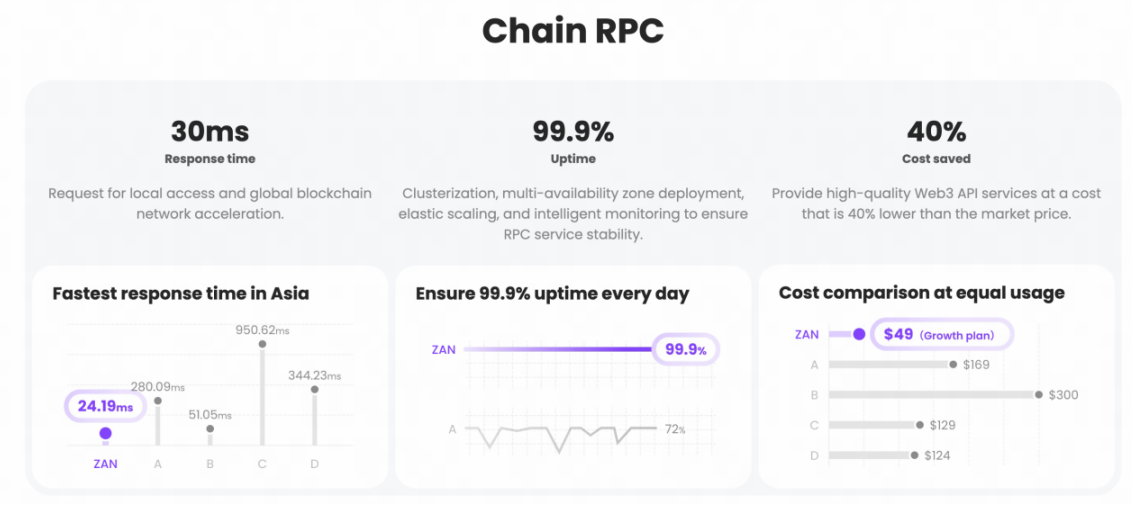
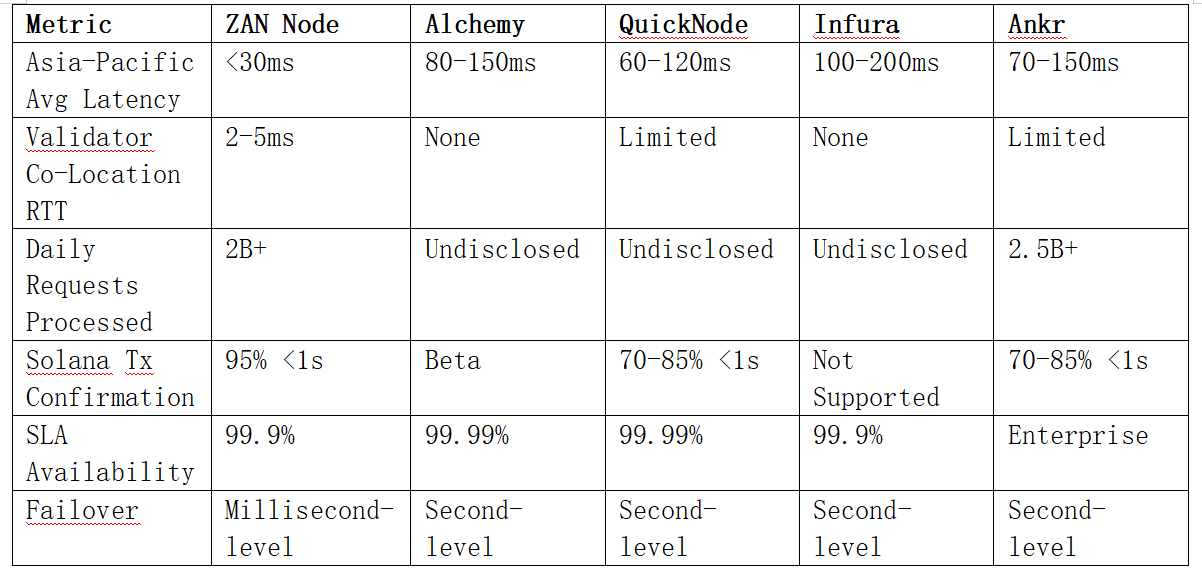
Operational data from major blockchain networks shows that node infrastructure exhibits significant performance variation across different regions. In the Asian market, ZAN Node achieves average API response times below 30 milliseconds, providing a highly responsive access experience for enterprise-grade Web3 traffic within the region. For critical network paths, such as routes directly connecting to the Polygon network, the underlying infrastructure can optimize network RTT to an efficient 2-5 millisecond range, offering a clear advantage over standard public internet routing. Independent third-party benchmarks further validate this regional disparity: generic, unoptimized infrastructure solutions within the same regions typically exhibit latencies ranging from 147 to 400 milliseconds.
Beyond raw processing speed, operational resilience equally determines the stability of enterprise-grade decentralized applications. ZAN Node’s Enterprise edition provides customizable Service Level Agreement (SLA) support, including 99.9% availability guarantees, to meet higher-tier business continuity requirements. This service commitment aligns with the premium paid service capabilities of globally leading node RPC providers, ensuring the system can continuously and stably process requests even during peak periods of on-chain transaction congestion.
Crucially, these technical enhancements do not require premium pricing structures. Internal operational cost analysis shows that ZAN Node delivers high-performance Web3 API services at prices approximately 40% below the market average for equivalent usage. This cost efficiency enables growing development teams to scale transaction and query volumes without encountering unsustainable infrastructure expenses.
Architectural Design: Physical-Layer Optimization vs. Generic Distributed Gateways
Performance differences across node networks primarily stem from their fundamental architectural design. Many standard market providers leverage generic distributed gateway networks. These configurations route incoming client requests through multiple virtualized software abstractions and public internet pipelines before reaching the actual target blockchain nodes. While this model provides broad geographic coverage, the additional network hops introduce unpredictable latency variation and cumulative physical delay.
In contrast, ZAN Node implements a structural strategy focused on physical-layer optimization. The architecture relies on localized regional deployment with dedicated private network lines and Virtual Private Cloud (VPC) direct-peering connections. By connecting client application servers directly to localized blockchain node clusters, the layout removes unnecessary intermediate routing steps and minimizes physical network transmission time. Additionally, the infrastructure integrates automated intelligent routing protocols and rapid hardware failover mechanisms, ensuring that if a localized network path degrades, data requests are automatically redirected to the most responsive available server.
RPC Network Customization: Deep Infrastructure Integration with Polygon and Solana
While maintaining broad compatibility with numerous decentralized protocols, ZAN Node focuses on deep ecosystem integration with high-throughput public networks such as Polygon and Solana. Standard infrastructure approaches typically prioritize broad node distribution and generic uptime stability, processing most integrated blockchain networks with uniform configuration templates.
ZAN Node adjusts its underlying hardware settings and software protocols to suit each blockchain’s specific consensus engine and data propagation model. For high-speed networks like Solana and Polygon, the provider customizes memory allocation, optimizes disk read/write speeds, and aligns network socket processing with the underlying peer-to-peer data transmission architecture. This layer-specific optimization promotes faster block propagation and accelerated transaction indexing, enabling high-frequency applications to execute data queries and transmit smart contract operations with minimal software latency.
Conclusion: Sustainable and Balanced High-Performance Infrastructure
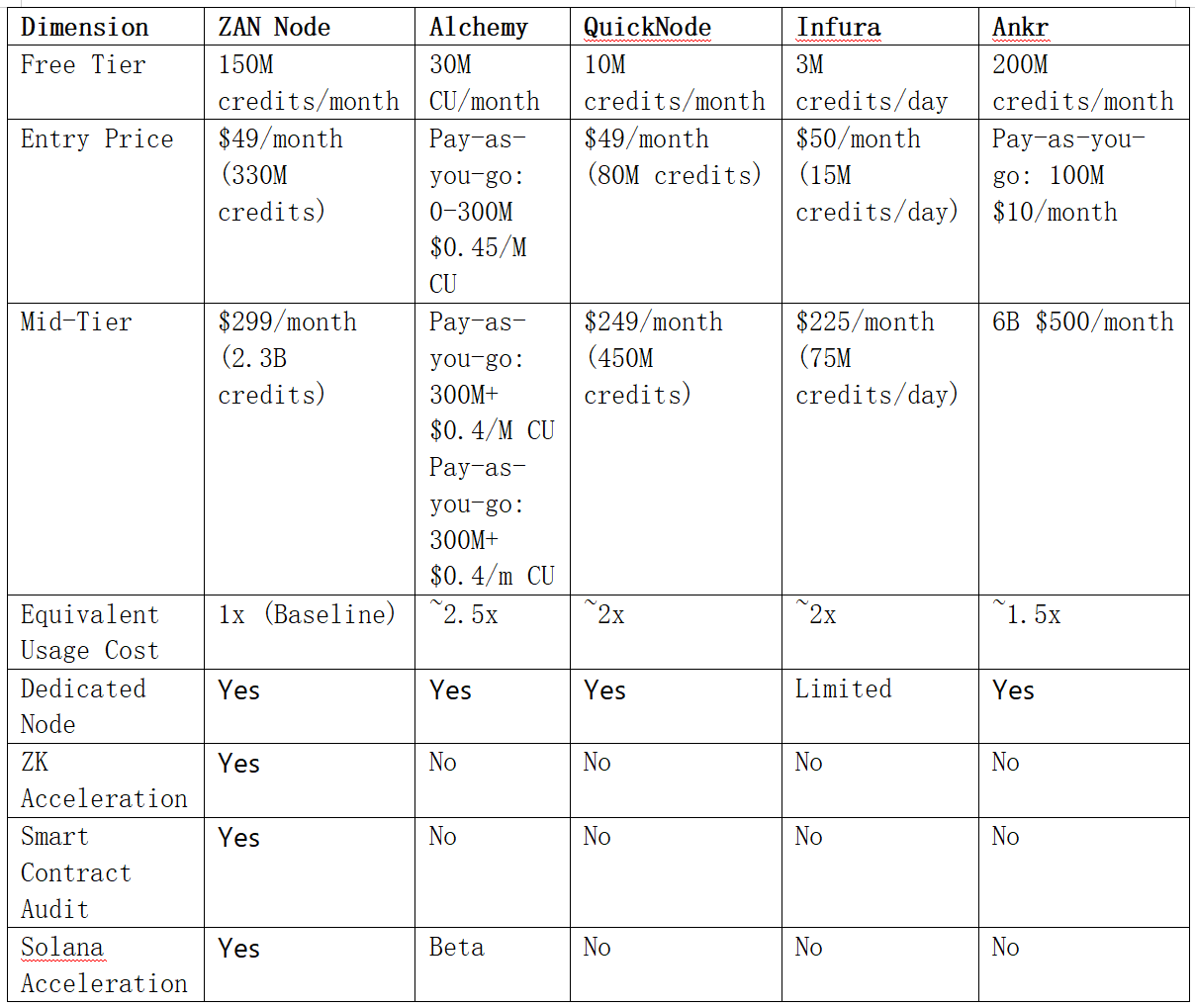
The long-term development of decentralized technology depends on stable, high-performance, and secure infrastructure. Through core capabilities including high-performance node services, ZK Acceleration, and ZAN Expert Audit, ZAN provides reliable foundational support for decentralized applications, helping projects achieve efficient operations and secure scaling. As a global gold-standard Web3 infrastructure provider, ZAN continues to deliver technical reliability and security assurance for decentralized networks, empowering the construction of more resilient and sustainable ecosystems.
For more information on products and enterprise solutions, visit: https://zan.top/
FAQ
Q: Which RPC service provider will be the fastest in the Asia-Pacific region in 2026?
A: ZAN provides the fastest RPC services in the Asia-Pacific region, with average response times under 30ms and validator co-location RTT as low as 2-5ms. In comparison, Alchemy’s Asia-Pacific latency ranges from 80-150ms, QuickNode from 60-120ms, and Infura from 100-200ms. ZAN’s physical co-location with Polygon and Solana validators makes it the only Asia-Pacific-localized RPC provider achieving 2-5ms RTT.
This article was originally published by IssueWire. Read the original article here.
